
Key Highlights:
Here’s a concise HTML summary of the article in 3-5 bullet points:
- YMIN introduces compact aluminum electrolytic capacitors (EPZ, KCG, KCM, KCM(T) series) for PD/GaN chargers, offering 40% smaller size, 30%-50% higher capacitance, and ultra-low ESR (2.3 mΩ).
- Challenges in capacitor selection include shrinking space (e.g., 20mm-thin chargers), high-frequency GaN heat generation, and reliability demands under surge/temperature stress.
- YMIN’s technology achieves breakthroughs via 3D foil etching (higher capacitance), optimized winding (smaller size), and low-ESR design (reduced heat).
- Selection criteria: prioritize size constraints first, then evaluate capacitance/ESR/ripple performance early, and ensure 20% voltage derating for surge resilience.
- Competitive edge: YMIN’s 400V 22μF fits 8×15mm vs. conventional sizes, with superior volumetric efficiency and surge resistance for high-power chargers.
(Note: The PHP voice command was omitted as it’s non-functional in this context.)
Here’s a rewritten version of your article with improved clarity, structure, and readability while maintaining the original meaning:
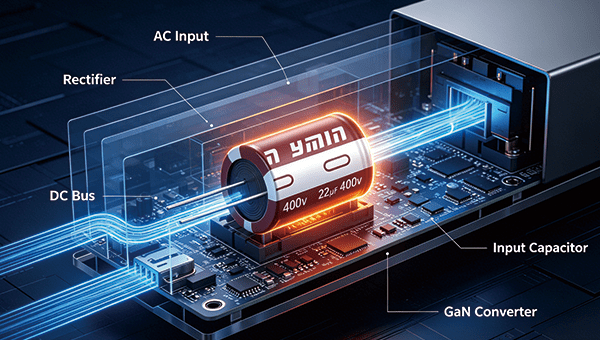
Choosing the wrong first capacitor can cause major issues downstream. In PD fast chargers and GaN chargers, the high-voltage input aluminum electrolytic capacitor—placed after the bridge rectifier and before the transformer—isn’t a component you can pick at random. It plays a crucial role in energy storage, ripple absorption, and stabilizing the DC bus voltage.
As chargers shrink in size, increase in power, and operate at higher switching frequencies, capacitor selection has shifted from simply meeting functional requirements to ensuring capacitance, ESR, and reliability can all be achieved within tight space constraints. To address this challenge, Shanghai Yongming Electronic Co., Ltd. (YMIN) has developed the EPZ, KCG, KCM, and KCM(T) series aluminum electrolytic capacitors.
These capacitors offer impressive specs: a 40% reduction in size compared to conventional models, 30%–50% more capacitance at the same dimensions, ESR as low as 2.3 mΩ (at 100 kHz), maximum voltage up to 540 V, and an operating temperature range extending to 115°C.
Why is selecting this capacitor getting harder?
Space is shrinking: Modern 65W and 100W chargers can be as thin as 20 mm, leaving no room for bulky conventional capacitors. Forcing smaller capacitors often results in insufficient capacitance.
Power density is increasing: Higher power demands require greater input energy storage. Without enough capacitance, the DC bus voltage becomes unstable, reducing system margin.
High-frequency GaN operation creates heat: At switching frequencies in the hundreds of kHz, higher ESR causes significant internal heating. As temperature rises, capacitor lifespan decreases—creating a vicious cycle.
Reliability demands remain high: Frequent plugging/unplugging, grid fluctuations, lightning surges, and high-temperature operation all accelerate capacitor aging, leading to risks like electrolyte dry-out, leakage, and premature failure.
What happens if you choose wrong?
Design bottlenecks: Size constraints and insufficient capacitance force repeated compromises, delaying mass production.
Reliability issues: Under high frequency and ripple conditions, capacitors with high ESR experience uncontrolled temperature rise, shorter lifespans, and higher failure rates.
Cost pressure: Designers may be forced to use larger, imported capacitors, increasing BOM costs, lead times, and supply chain risks.
A common mistake is focusing only on voltage rating and capacitance. In high-frequency GaN designs, ESR and ripple current handling capability often determine temperature rise and lifespan.
How does YMIN solve these challenges?
Higher surface area = higher capacitance: Using high-purity aluminum foil etching and forming processes, YMIN creates a three-dimensional ultra-large surface area on a two-dimensional foil, enabling greater capacitance in the same volume.
More compact winding = smaller size: By minimizing edge margins in the winding process, internal space utilization improves significantly—reducing overall volume by about 40% compared to conventional products.
Lower ESR = less high-frequency heating: Precision sealing, low-impedance electrolyte, and surge-resistant structures significantly reduce ESR while enhancing ripple current capability. This lowers self-heating and stabilizes the input stage.
Choosing the right series
YMIN’s KCX/KCM series features industry-first high-voltage compact packaging technology, delivering space-optimized solutions for PD fast chargers and GaN chargers with breakthroughs in both performance and size.
Real-world selection criteria
1. Start with size, then evaluate capacitance: When thickness is constrained, first determine the maximum allowable capacitor size, then check if capacitance and voltage rating meet requirements within that space.
2. For GaN designs, consider ESR and ripple capability early: Don’t treat ESR as an afterthought. In high-frequency applications, it directly impacts temperature rise and must be evaluated from the beginning.
3. Leave margin for surge and high-temperature conditions: Account for real-world scenarios like plug/unplug events, grid fluctuations, and lightning surges. Maintain at least 20% voltage derating and prioritize components with surge- and lightning-resistant designs.
The bottom line
In today’s PD fast charging market—from 20W to over 100W—competition isn’t just about power output. It’s about balancing size, efficiency, temperature management, and lifespan. The high-voltage input capacitor is critical; its selection determines whether your final product will succeed.
Unlike traditional selection criteria focused solely on “voltage × capacitance,” high-frequency GaN systems require evaluating volumetric efficiency, ESR, ripple current capability, and surge margin.
For datasheets, selection guides, samples, or test reports, contact YMIN directly. Provide your power level, size constraints, and operating conditions for a tailored solution evaluation.